
If you’re planning to sit an English test for study, work, or migration, you’ll notice some big changes coming to PTE from 7 August 2025. Here’s a breakdown of what’s new, how it affects you, and why IELTS continues to be a trusted choice.
What’s Changing with PTE?
From 7 August 2025, PTE will look a little different:
- Two new question types
- Summarise Group Discussion
- Respond to a Situation
These tasks add new challenges. You’ll need fresh strategies and updated prep materials, as old approaches may no longer work.
- Human marking added
For the first time, some Speaking and Writing responses will be reviewed by human assessors alongside AI. Pearson hasn’t confirmed which questions this applies to or exactly how scores will be calculated. - Extra questions, same test time
There will be more questions overall, but no extra time. You’ll need to move faster through the test without any changes to per-question limits.
What This Means for Test Takers
- More complex preparation – You’ll need to learn two new Speaking tasks and purchase updated study materials.
- Harder pacing – More questions in the same time means extra pressure.
- Less reliance on templates – Pre-prepared answers won’t help; PTE is tightening rules on memorised responses.
- Scoring uncertainty – Human review adds a layer of subjectivity without clear guidance on how marks will be awarded.
- No partial retakes – If you miss your target score, you’ll need to retake the entire test and pay the full fee again.
Why IELTS Makes It Simpler
Global recognition
IELTS is trusted by more than 12,500 organisations worldwide, including governments, universities, and employers.
Stable and predictable
The test format hasn’t changed. You can prepare with confidence, knowing what to expect on test day.
Clear marking
- Listening & Reading: auto-marked for accuracy.
- Writing & Speaking: marked by expert human examiners using transparent, published band descriptors.
Flexible retake options
IELTS is the only major English test offering One Skill Retake (OSR). If you fall short in one area, you can resit just that skill instead of redoing the entire test. The Australian Department of Home Affairs accepts IELTS OSR for most visa subclasses, including the Temporary Graduate visa (subclass 485) for tests taken after 7 August 2025.
Ongoing approval for migration
IELTS recently signed a new three-year agreement with the Australian Department of Home Affairs, reaffirming its place as a trusted English test for visas and migration.
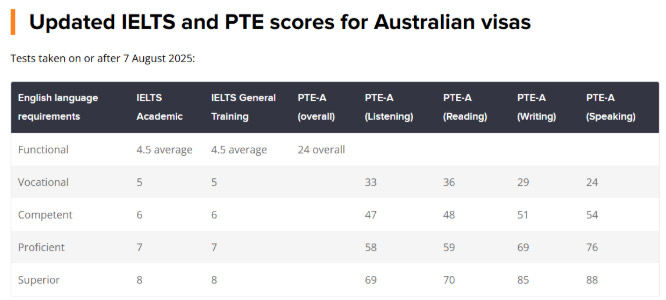
Source: Department of Home Affairs
IELTS vs PTE: Key Takeaways
- Retake flexibility: IELTS offers One Skill Retake; PTE requires a full test resit.
- Scoring clarity: IELTS uses transparent marking by human examiners. PTE mixes AI with some human review but hasn’t clarified how.
- Format choice: IELTS is available on paper or computer; PTE is computer-only.
- Recognition: IELTS is accepted by more organisations worldwide, including more immigration departments.